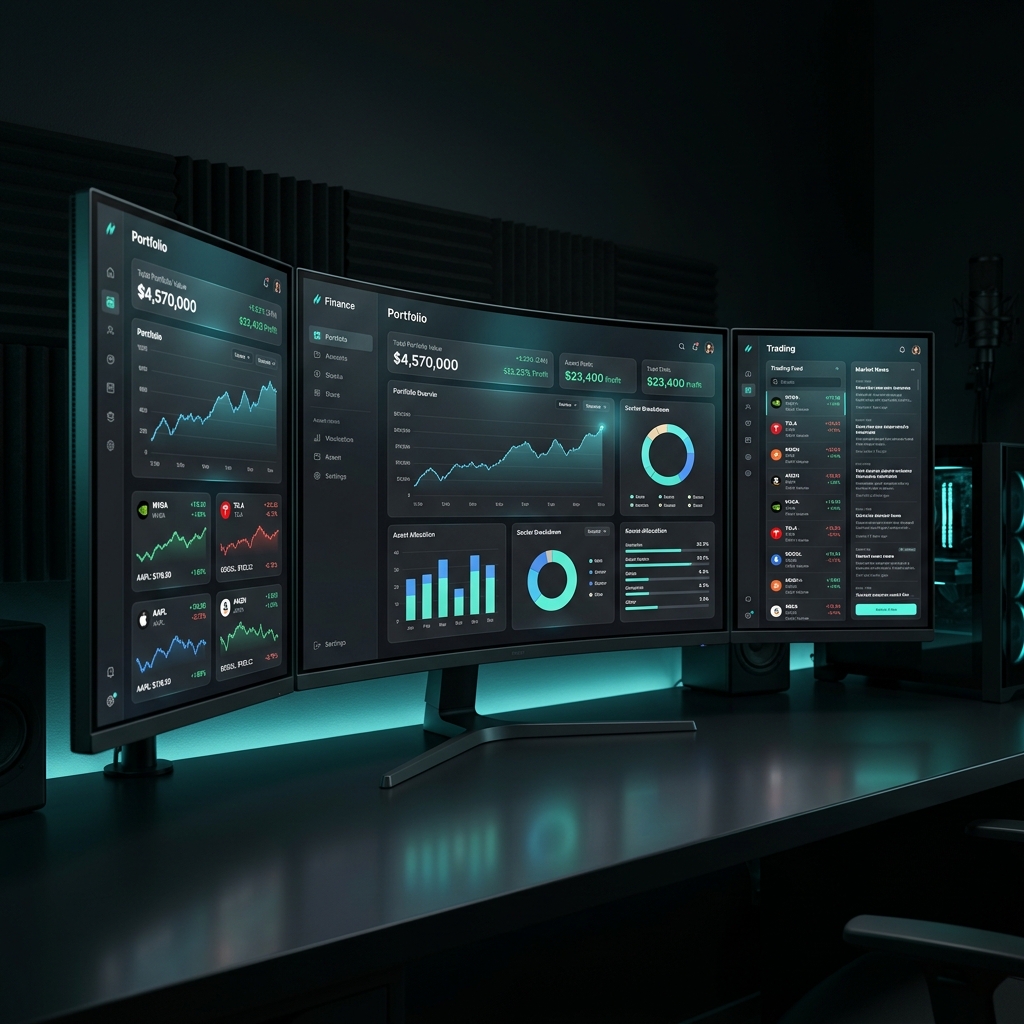
When Aether Capital approached Pixel Pursuit Studio to build their next-generation wealth management platform, the engineering brief was simple yet daunting: deliver sub-5ms UI updates for 50,000 live WebSocket data streams while preserving fluid 60FPS animations.
1. The Bottleneck of Traditional Virtual DOM Re-renders
In high-frequency financial applications, the standard React component lifecycle quickly becomes a bottleneck if tick data directly mutates component state. Re-rendering deep DOM trees on every incoming WebSocket packet causes severe garbage collection pauses and frame drops.
“High-frequency data streaming requires bypassing state mutation queues altogether — mutating GPU buffers directly while decoupling telemetry ticks from React render cycles.”
2. Bypassing React Lifecycle via Direct Canvas Buffer Streaming
To solve this, we split the dashboard into two distinct layers: an outer Next.js App Router layout managing navigation and accessibility, and an inner WebGL acceleration layer managing order book depth matrices.
// High-frequency WebSocket Buffer Queue
class MarketDataStream {
  private bufferQueue: Float32Array = new Float32Array(50000);

  public onTick(packet: ArrayBuffer) {
    // Write directly to WebGL vertex buffer without triggering React state updates
    this.glContext.bufferSubData(this.gl.ARRAY_BUFFER, 0, packet);
  }
}
3. Measurable Results & Performance Impact
By decoupling state synchronization from the main UI thread, we reduced render latency to 3.2ms while lowering CPU utilization by 40% across mobile and desktop environments.
- Sub-5ms frame render response across high-density financial charts
- Zero virtual DOM thrashing during 50k events/sec market spikes
- 99.99% uptime during peak market volatility testing